via PlayStation
God of War Laufey is officially the next mainline entry in the series, with the titular Faye waking up after her own funeral in a place called the Everywhen. Death was supposed to be the end for Laufey, but the setup sends her into the afterlife of the gods to protect Kratos and Atreus from a threat that has outlived her.
The Everywhen is the place where all magic begins and returns, a realm where gods and creatures from different mythologies come together. PlayStation has already named two of the gods Faye will encounter there, Sekhmet and Begtse, both of which are clearly less than friendly toward newcomers.
The extensive reveal trailer shown at the June 2026 State of Play turned the entire franchise on its head in just a little over 20 minutes. The Norse saga still matters, especially with Faye at the center, but Laufey is already reaching beyond Odin, Thor, Freya, and Týr. Some of its new figures have clear roots in real-world mythology. Others, like Phranque, Rue, the sword, and the boy Faye frees from a cage, are harder to place. For now, the trailer gives us enough to start sorting the known from the unknown.
THIS ARTICLE CONTAINS SPOILERS FOR GOD OF WAR (2018) AND GOD OF WAR RAGNARÖK
Sekhmet, The Egyptian Goddess Of War And Healing
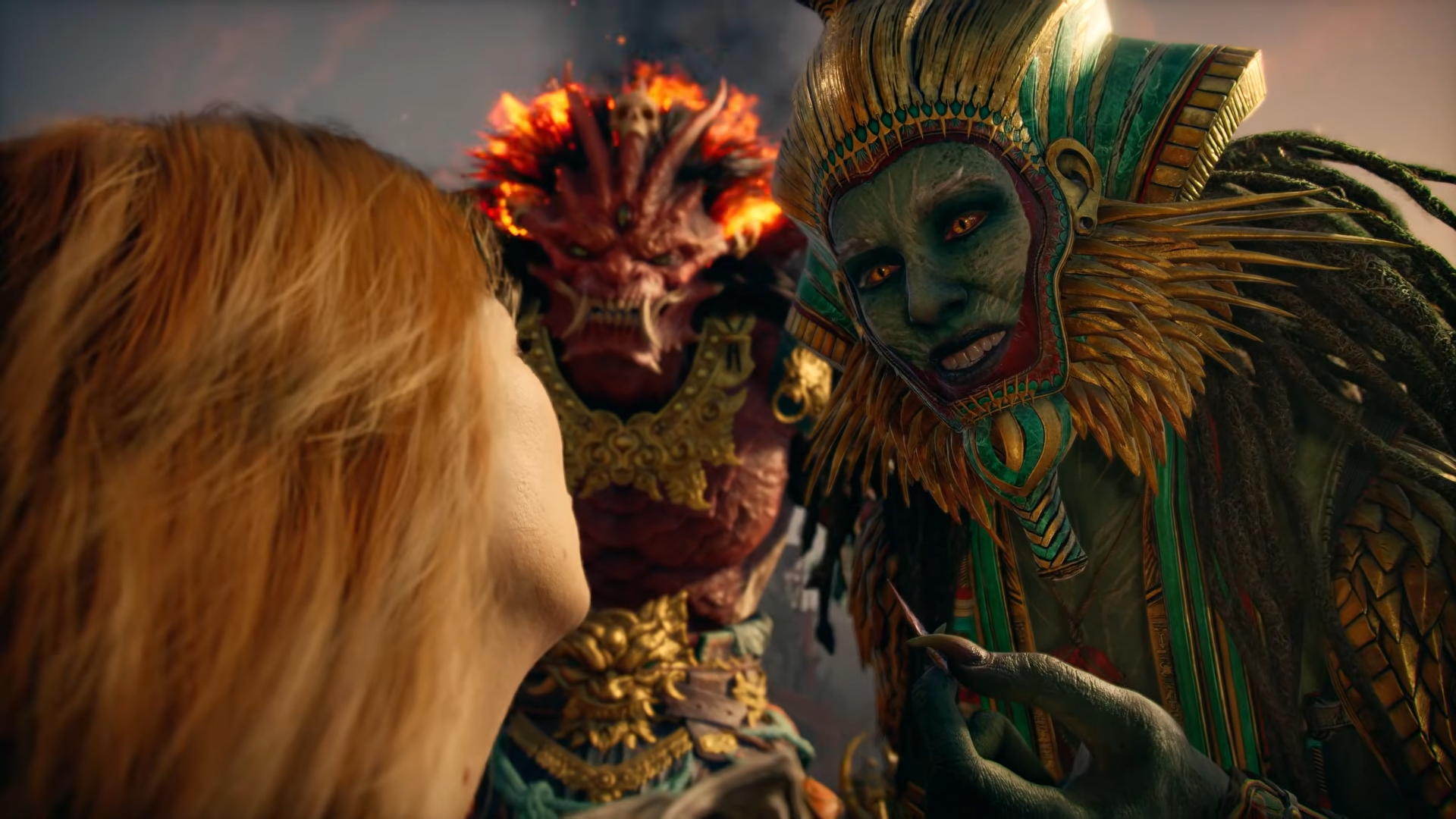
Sekhmet is one of the clearest mythological figures connected to the trailer. In Egyptian mythology, she is usually depicted as a lioness-headed goddess, often wearing a solar disk. She is associated with war, destruction, plague, protection, and healing.
Sekhmet is violent, but she is not a simple battle goddess. She is closely tied to Ra, the Egyptian sun god, and is often described as the Eye of Ra. In that role, she acts as divine wrath sent against enemies and threats to cosmic order.
Her connection to disease and medicine is just as important. In Egyptian religion, the same divine force that could send sickness could also remove it. Sekhmet could destroy, protect, punish, and heal, giving her a wider range than a god who only represents combat.
Sekhmet could bring a very different kind of war figure into the series. Ares represented cruelty and manipulation. Thor represented inherited violence and obedience. Sekhmet brings war as heat, plague, punishment, and cure.
She also points toward a mythology fans have expected God of War to explore for years. Egyptian religion is full of death gods, sun gods, monsters, underworld imagery, and divine judgment. Sekhmet gives the trailer an immediate connection to that world without requiring the game to fully move into Egypt.
Begtse, The Wrathful Protector From Tibetan And Mongolian Tradition

Also known as Begtse Chen or Jamsaran, Begtse is associated with Tibetan Buddhist and Mongolian tradition. He is often described as a wrathful protector deity, or dharmapala, which makes him a bit different from a straightforward “god of war” in the Greek or Egyptian sense.
Wrathful protector figures are meant to look frightening. Begtse imagery can involve armor, weapons, flames, blood, skulls, and a fierce red appearance. But in Tibetan Buddhist contexts, wrath does not automatically mean evil. A wrathful protector can defend sacred teachings, destroy obstacles, and subdue hostile forces.
There could be more to Begtse than the brute we see in the trailer. If the recent God of War games have taught us anything, his violence can be protective rather than purely aggressive. He can look monstrous without functioning like a simple villain.
His inclusion also makes the trailer feel less predictable. Egypt has been an obvious future direction for God of War for years. Tibetan Buddhist and Mongolian mythology is a much less expected source for a mainstream action game. If Begtse is part of the Everywhen, then Laufey may be pulling from a much wider range of traditions than fans expected.
Although he’s portrayed as a villain in the trailer for Laufey, Begtse shares some similarities with Týr from God of War Ragnarök. Both figures push against the simplest version of a war god. Týr connects war to law, oaths, justice, and sacrifice, while Begtse connects wrathful violence to protection and the defense of sacred order. They come from very different traditions, but both give God of War a way to treat war as something more disciplined than bloodshed.
Phranque, Rue, The Sword, And The Caged Boy Are Still Mysteries
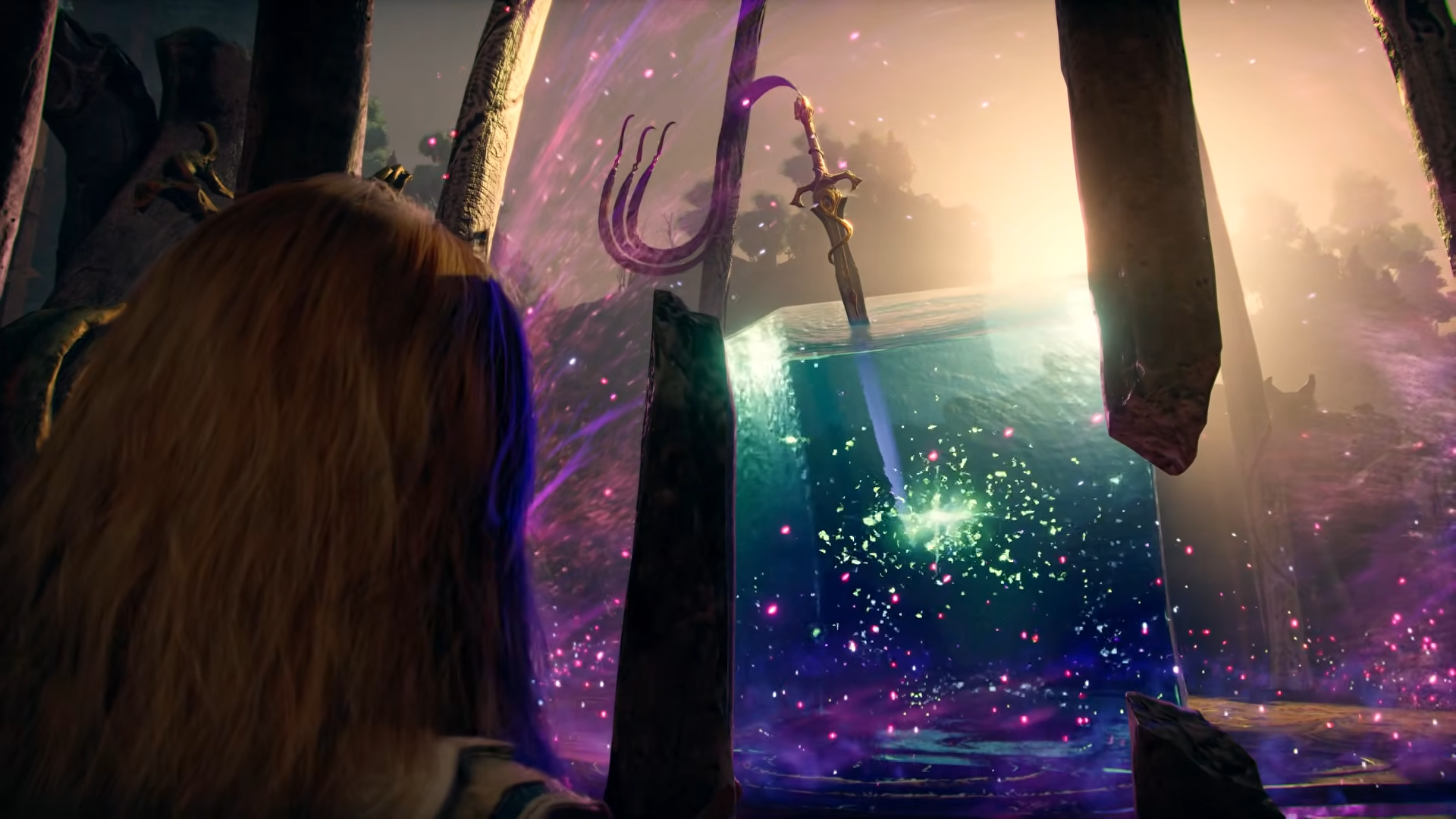
Not every new figure in the trailer has an obvious mythological identity.
Phranque is the strangest-named character so far. He is a gelatinous cube voiced by Jack Quaid, and his shape has already invited speculation. Some viewers have compared him to Metatron’s Cube, the Black Cube of Saturn, sacred geometry, or other cube-related symbolism.
Those theories make some visual sense, but none of them should be treated as firm yet. Metatron’s Cube is a sacred-geometry symbol, and the Black Cube of Saturn is more of an esoteric motif than a clear mythological figure. Phranque may use cube symbolism without being a direct reference to either one. For all we know, he could just be a reference to Dungeons and Dragons‘ gelatinous cube monster.
The more concrete detail is Jack Quaid’s history with the franchise. Quaid previously voiced Atreus of Sparta, the very warrior Kratos named his son after, in God of War Sons of Sparta. That does not prove Phranque is tied to the Greek games, but it is a specific callback worth mentioning in a series where names, legacies, and dead warriors tend to matter.
Rue is easier to describe and harder to explain. Early descriptions identify Rue as the talking ribbon attached to Faye’s sword. That makes Rue sound less like a deity and more like a guardian, seal, companion, or magical restraint.
The sword may be the bigger mystery. God of War weapons usually carry history, not just stats. The Blades of Chaos, Leviathan Axe, Draupnir Spear, and Mjölnir all come with meaning attached. If Rue exists to contain or guide the sword’s power, then the weapon could be a divine artifact, a god-killer, a prison, a key, or something original to the Everywhen.
The boy Faye frees from a cage is even harder to place. So far, he does not have the same obvious mythological tells as Sekhmet or Begtse. He could be a named god, a captured spirit, a native being of the Everywhen, or simply a character whose identity the trailer is hiding.
For now, Phranque, Rue, the sword, and the caged boy are best treated as open questions.
The Everywhen Could Bring Back Gods From Past Games

The trailer’s afterlife setting also opens the door for returning gods.
If the Everywhen is an afterlife for gods, then Laufey has a clean way to revisit dead characters without undoing the events of the earlier games.
Ares is the obvious name to discuss. He was the original Greek God of War, the first major divine antagonist in the series, and the god whose manipulation of Kratos set the franchise in motion. If Laufey is introducing war figures like Sekhmet and Begtse, Ares would fit naturally as the Greek version of that idea.
Other Greek gods could also make sense. Zeus would bring back the family trauma at the center of Kratos’ original story. Hades would be a fitting presence in a game about a divine afterlife. Athena remains one of the series’ strangest unresolved figures, especially because her role after the Greek saga was never as simple as the other Olympians.
The Norse gods are also possible, depending on how time works in this new realm. Thor and Odin are dead by the end of Ragnarök, although Odin’s soul was destroyed by Sindri, and the Everywhen could give the series a way to use them again without pretending their deaths did not matter. Baldur, Heimdall, Magni, and Modi could also appear, depending on how broad the afterlife setting turns out to be.
That does not mean Laufey should bring everyone back. The premise would lose weight if the Everywhen became a crowded reunion tour, although I would love to see how the Greek pantheon might react upon meeting their new in-law.
About the Author

Discover more from Bonus Action
Subscribe to get the latest posts sent to your email.