

I played The Artful Escape this weekend because Mixtape comes out tomorrow, and I wanted to know what Beethoven & Dinosaur are actually capable of before I trusted them with a few more hours of my life.
What I got was a side-scrolling acid trip about a teenage guitarist from a fictional Colorado town who tours alien planets and invents an intergalactic rock persona for himself, and what I learned is that this studio is capable of something most developers aren’t: building a game that strips out every system meant to make you feel good, replaces it with pure concentrated coolness, and gets away with it completely.
No XP Was Harmed in the Making of This Game
The Artful Escape is the least gamified game I have ever played. There are no XP bars, skill trees, faction meters, or branching paths. You walk right, you jump occasionally, and you hold a button to shred guitar while you do it. When you shred, the whole world lights up, and the alien creatures around you start dancing, which feels extraordinary and contributes nothing to your progression.

The rhythm sequences, where you echo notes back to communicate with beings who are, frankly, enormous and intimidating, restart if you fail them and do not penalize you in any other way. There is no scoring or consequence. There is no “Git Gud ” in The Artful Escape, only feel-good. The question the game is quietly asking the entire time is whether that’s enough.
It is, and the reason it is takes some unpacking.
I Am From a Planet That Ratifies a New Official Language Every Three Hours
When Stargordon, the galactic talk show host voiced by Mark Strong, asks your alter ego where you come from, you choose from a list of home planets that are each their own tiny, committed joke.





One is a world that brews milk, transporting everyone who drinks it to a Manchester dance party in September 1987. Another is a planet whose government ratifies a new official language every three hours. These choices feed back into the interview scene and mean nothing narratively, which critics noted with varying degrees of irritation.
What those critics missed is that lingering on that menu is one of the most pleasurable three minutes in the game, because the writing assumes you are smart enough and weird enough to appreciate exactly this kind of specific, confident absurdity. That assumption is the design philosophy. The Artful Escape is not a game that flatters you with numbers going up. It flatters you by deciding you have taste.
Even Bob Dylan Went Electric
It helps, enormously, that the game was made by someone who knew what he was trying to say. Johnny Galvatron, the lead guitarist of Australian rock band The Galvatrons, spent nearly a decade on tour with a Warner Bros. record deal before burning out and pivoting to game development.
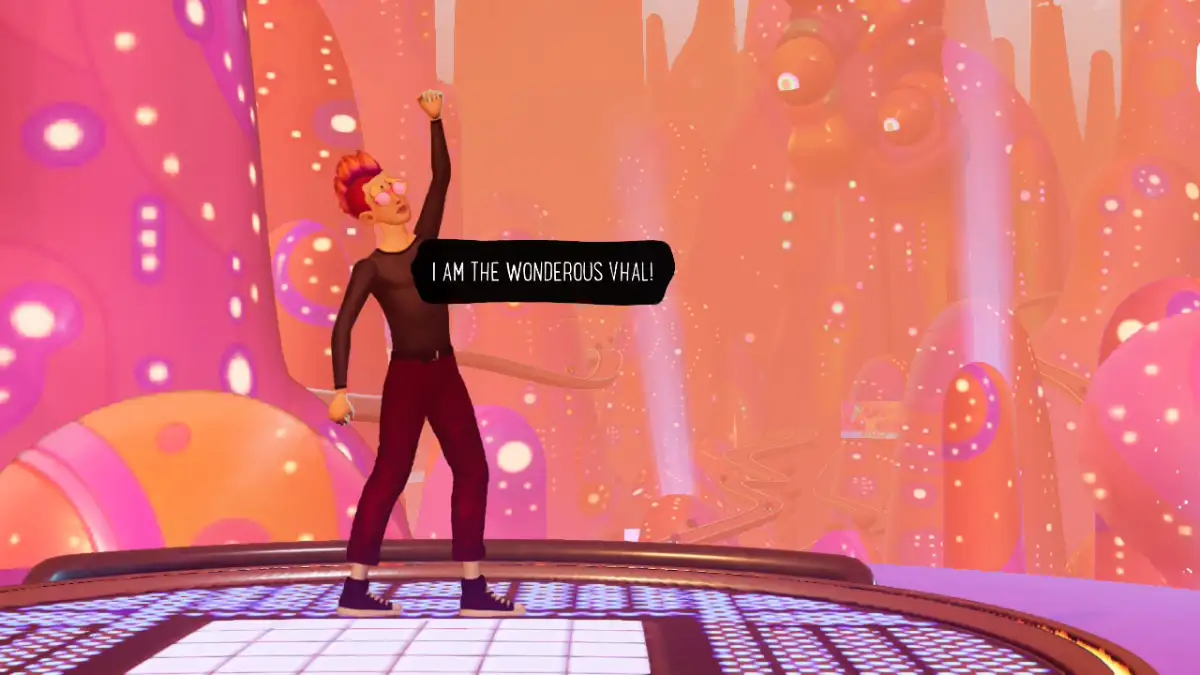
He described The Artful Escape as “David Bowie traveling off from London on an interstellar trip to create Ziggy Stardust.” The game’s entire thesis, that the invention of a persona is its own form of artistic courage and deserves its own kind of journey, comes from a person who actually lived the weight of being expected to be one thing while wanting desperately to be another.
Carl Weathers plays Lightman, the aging rock god who takes Francis under his wing, and his performance is so warm and specific that it makes the whole thing cohere in a way the mechanics never could have on their own.
I am not going to pretend The Artful Escape is perfect. It is short, around three to four hours, and some of its worlds feel thinner than others; there are critics who found the whole experience weightless in a way that frustrated rather than freed them. I understand that.
But I think getting away with weightlessness at this altitude is genuinely harder to pull off than adding a skill tree, and Beethoven & Dinosaur pulled it off. Mixtape is their second attempt at the same essential bet: that style and feeling can carry a game further than systems, that the right three hours can stay with you longer than the right hundred. I am playing it tomorrow. I already know they have earned the right to make it.
About the Author

Discover more from Bonus Action
Subscribe to get the latest posts sent to your email.