

Amberspire Review Ludology Now
Would I have been interested in Amberspire if didn’t know it was made by someone at Bithell Games? That’s the question I’ve asked myself multiple times over the past week. I can stay up until 4 a.m. playing ‘just one more round’ of Civilization with the rest of them, but it’s not usually something I seek out unless I’m in a very specific mood. Of those types of games I’ve tried that aren’t Civ, none seem to stick. Until now.
It’s the randomness that gets me, I think. So much of Amberspire is based on dice rolls, and over the last couple of years I’ve really been bitten by the RNG itch. Maybe that’s why I never bounced off Blue Prince like so many poor souls did. Imagine missing out on the best game of 2025 just because you don’t like trying things over again. That could have been me. It probably is – there are whole genres and art styles I just don’t play because it’s not my thing, and there are hundreds if not thousands of GOTY contenders amongst them.
The basic gameplay loop of Amberspire sees you clicking on your current buildings to gain resource dice, rolling those dice, then allocating those resources towards either the construction of new buildings, the eradication of environmental dangers like water, rust, and fog, or selling those resources to gain Influence. As you accumulate resources you are also occasionally accumulating “instability” and “weather” dice, which must be rolled every four turns.
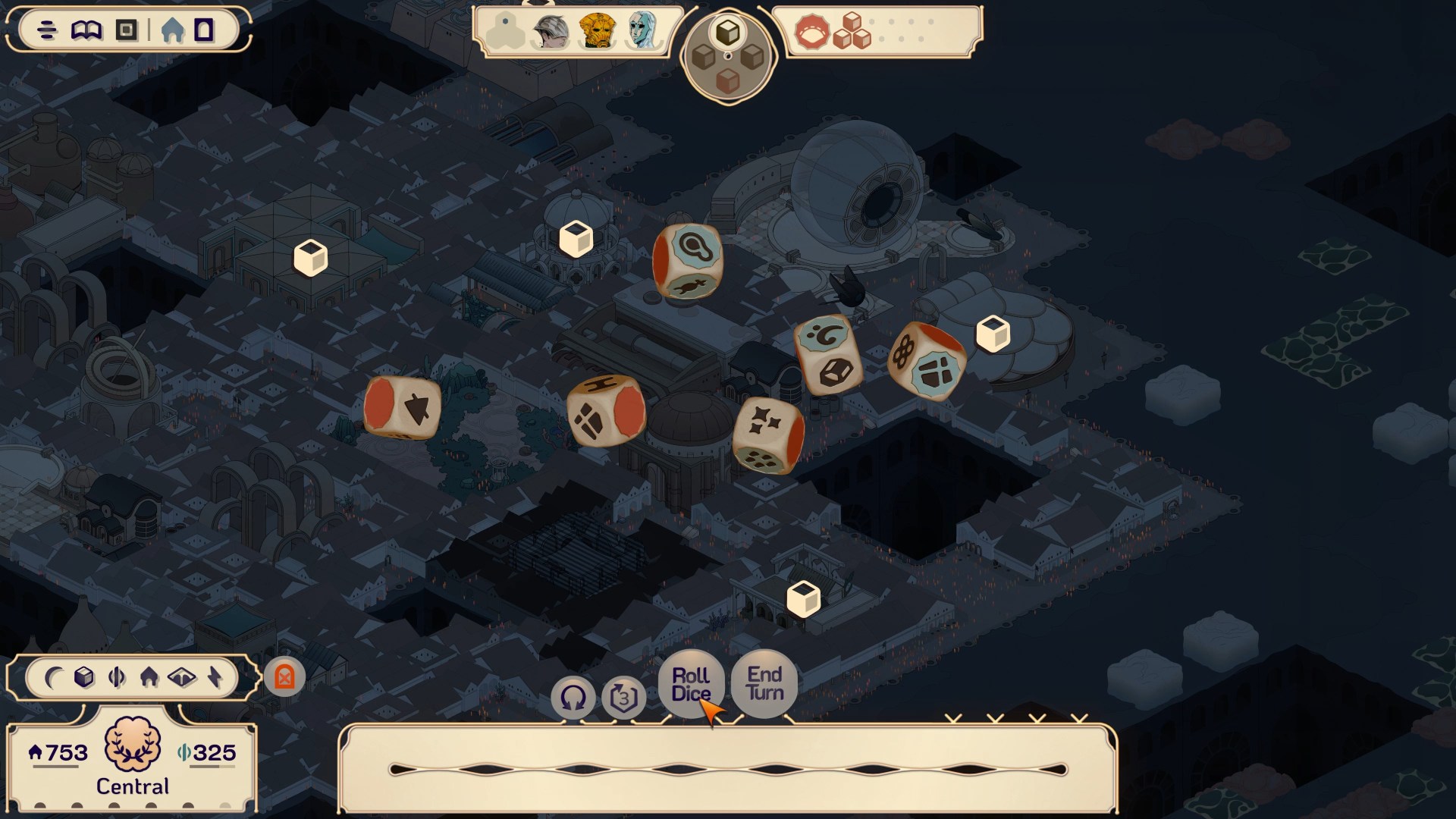
I was a bit confused by the mechanics of Amberspire at first, but that was more my own fault than anyone else’s. I tend to jump into city builders with a ‘how intuitive is this?’ attitude on my first attempt, and the answer is usually ‘not very.’ However, once I realized each building in Amberspire has a certain amount of range its resources can be allocated in, I was off to the races.
Again, this was my own fault. Amberspire contains a thorough in-game manual (and an external PDF file, a lovely touch) which tells players everything they need to know about the mechanics of the game, one which I eventually did read through and learned much from. I never played any of the Anno titles (which developer Nic Tringali stated was a direct influence on Amberspire) but, if it’s anything like this, I might need to seek them out.
Amberspire feels like playing a one person board game, and I mean that in the best way possible. Players roll dice to see whether they get resources or not, buildings must be placed correctly to receive said resources, and even the negative effects that can occur happen either via dice rolls or random events could very well just be drawing cards from an event deck. It’s excellent stuff.

If I had any complaints about Amberspire, they would likely fall under the ‘optimization’ category. For such a small file size the game sure makes my PC run quite hot after only a short period of play, and every five minutes or so there is an occasional three- to five-second hiccup that causes the game to freeze completely before eventually coming back to itself. It’s a small complaint, but it was occasionally frustrating when I would try and click on a resource die to allocate it but the game refused to register my actions because it was currently having a hot flash.
Between this, Disco Elysium, and Citizen Sleeper, I am fully convinced at this point you could add dice rolls to basically any genre and it would become something interesting. I would love to see a stealth game that played with randomness in such a way, or a one-on-one fighting game. What would that look like? I dunno. Someone get on that.
Ultimately, I think Amberspire succeeds in what it set out to do, which was to make a fun, engaging city builder based around rolling dice. The art style is lovely and the music and sound effects are solid. Over the past week I’ve continued to jump in and play Amberspire far longer than I originally intended, and (despite some fog-related setbacks) I eventually brought my city from a tiny little community into a brand-new golden era of prosperity. It felt good. Go check it out.
NOTE: A Steam code was provided by the developers for the purposes of this column.
THIS WEEK’S RECOMMENDED MEDIA:

About the Author

Discover more from Bonus Action
Subscribe to get the latest posts sent to your email.