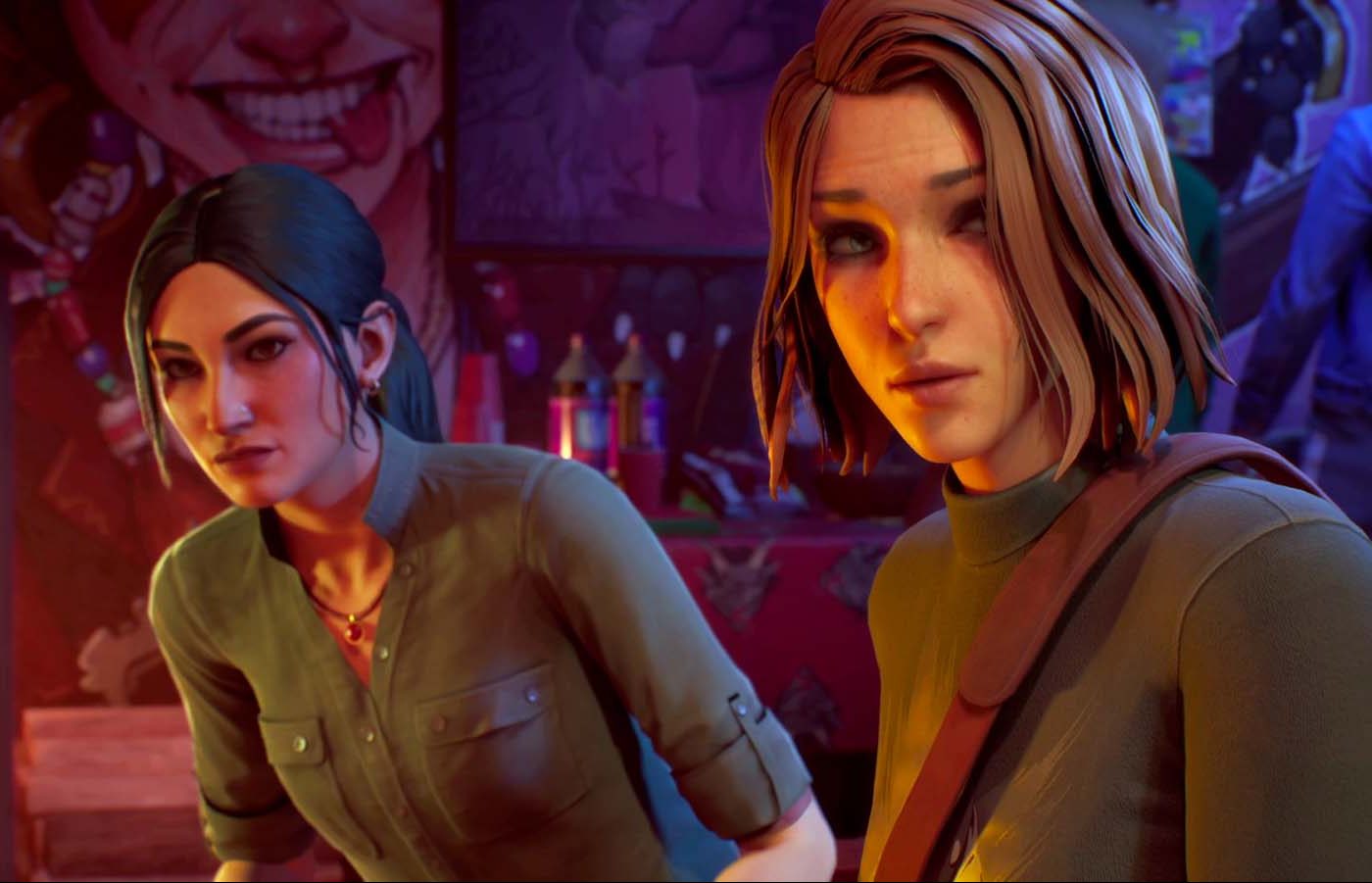
If you try to rewind time in the first chapter of Life is Strange: Double Exposure, Max chuckles a dry, “Rewind hasn’t worked in years.”
This is the first not-so-gentle hint that I’m far from Arcadia Bay now. No Blackwell Academy or Two Whales Diner outside this dilapidated bowling alley.
This is also not teenage Maxine Caufield – though she’s still breaking into buildings. This socially inept high school student is now in college… as an Artist in Residence. In her own words, she’s an “authority figure… kind of.”
With a new best friend, soon-to-be-discovered dimension powers, and a much chillier setting, I prepare to embark on a fresh journey with a familiar face.
And I will. Just give me a few minutes to read 59 ancient messages from my ex Chloe Price and pretend I’m not dying inside while revisiting the post-breakup saga in my journal.
Max the Snoop Caufield
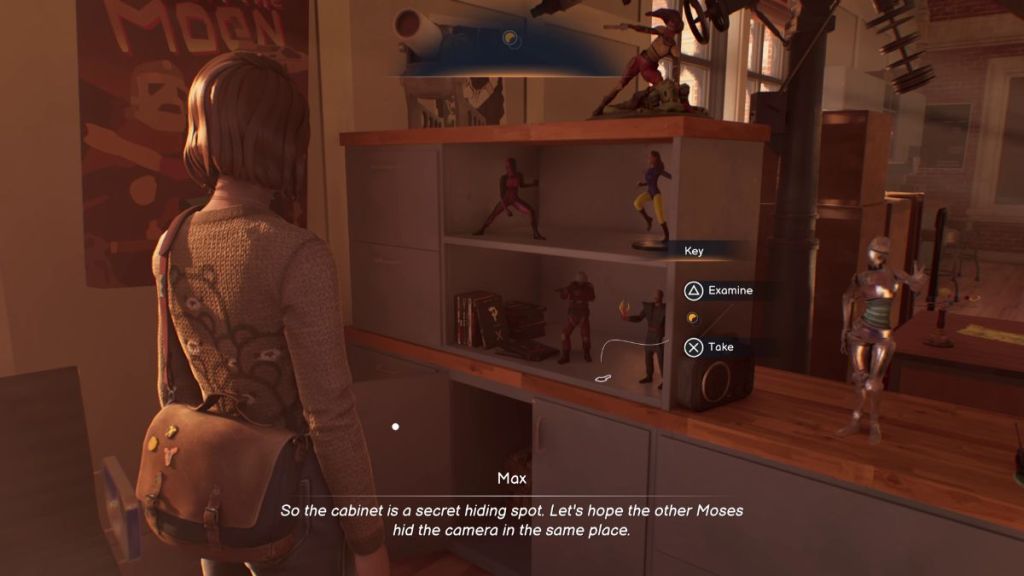
Once you finally pry yourself away from the phone and face reality, you’re back to Max’s usual antics: you know, darting around every inch of a room, hunting for random stuff or people to interact with.
Honestly, I’m convinced Max’s powers go way beyond time travel and dimension-shifting. How else could I feel so cool with rummaging through people’s laptops, phones, and other super private belongings?
That’s part of the charm of Life is Strange. Snoop hard enough, and suddenly your sworn enemy, Victoria Chase, feels like your twin. Snoop even harder, and you might just save your classmate Kate from herself.
Good news: the years haven’t dulled Max Caulfield’s world-class snooping skills. And, yep, just like before, your nosy ways do not go unnoticed by other characters.
The thrill of someone bursting in mid-snoop? Doesn’t faze her. Sure, she can’t rewind anymore, but hey, jumping dimensions to dodge getting caught works just as well.
And if that doesn’t impress you, she’ll eavesdrop from one dimension into the next.
Max is a total force of nature. How could I not be on board?
So Long, Arcadia Bay

The variety of locations you explored in the original game—Frank’s van, the train tracks, Joyce’s diner, Chloe’s room—have all been scaled back to just one place: the Caledon campus.
But wow, is this campus stunning. From the library’s grand mahogany shelves and artfully decorated cafeteria halls (it is an art college, after all) to the charmingly frat Snapping Turtle bar, Caledon is a visual treat.
Of course, the vibe changes depending on which dimension you’re in. Tear open a portal, and you’ll see a little note at the top of the screen: “Living World” (Safi’s alive!) or “Dead World” (yeah… not so much).
But it’s not just Safi who switches between alive and dead—everything does. In the “Dead World,” you’ll notice the gloomy lighting, bare walls, and everyone’s utterly miserable expressions. Meanwhile, the “Living World” is full of pranks, smiling students, and bright yellow light.
Having just a few areas to explore let the devs pack a ton of detail into each one. I’m sure fans will be analyzing every bit of graffiti and posters on the walls for months, piecing together theories.
That said, the fun of exploration fades after the first couple of chapters. You’ll barely see any new places, and this makes Caledon feel a lot smaller than Arcadia Bay.
Bumps in the Road
Unfortunately, not everything is an immersive experience in Life is Strange: Double Exposure. Textures can take their sweet when loading, and I ran into a bizarre bug in Chapter 3 where I got teleported straight into a heated—but totally silent—argument with Lucas Colmenero. Thankfully, it didn’t softlock me, but after three playthroughs, I still haven’t experienced that scene the way it was supposed to play out.
I also have a bit of a gripe with the outfit choices in the game. At first, it’s great having the ability to switch things up, but by Chapter 2, I’m explaining to Moses why I ghosted him because I was wrecked over Safi’s death… while rocking a Moogle beanie.
Or I’m having a devastating breakup with Safi while sporting blue hair (temporary dye, I assume?) and a white turtleneck with a skull and crown.
Look, I love Final Fantasy, and Chloe Price is one of my all-time favorite characters—but these outfits felt wildly out of place given the emotional context. Choice is cool, sure, but I just wish the clothes were a bit more grounded and fit Max’s vibe, instead of feeling like random costumes.
The big butterfly in the room
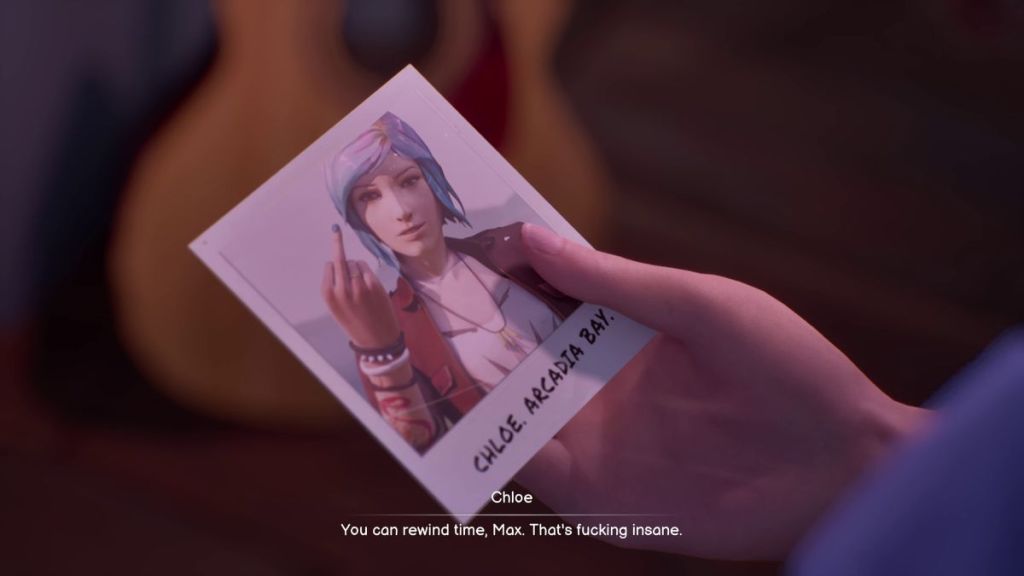
Max and Chloe aren’t together here – even if you chose to sacrifice your hometown to save her. Maybe that’s exactly why.
But don’t worry, Life is Strange: Double Exposure hasn’t hit CTRL ALT DELETE on Chloe from Max’s life. It also doesn’t pretend the events of the first game never happened.
Chloe’s no longer Max’s girlfriend, but her presence weighs heavily. You’ll scroll through her social media posts, watch her interact with others from a distance, carry her picture in your wallet, and even hang Polaroids of the two of you on your bedroom wall.
Max’s journal has a few vague entries about what went down between them, and yes, you can scroll through their entire text history (trust me, I did). I even went so far as to read all of Victoria’s posts, obsessively checking my phone at the start of every scene, hoping Chloe might miraculously text me.
But eventually, it hit me: she wouldn’t.
Life is Strange constantly nudges Max to move on from her past. In fact, that seems to be a big reason behind the breakup in the first place.
It felt oddly personal to be told that, almost like the game was telling me to move on from those events, too.
At first, I wasn’t all that thrilled about embracing the new romance options in Double Exposure, but with dialogue this good, resistance is futile.
Double Exposure is unapologetically queer. Maxine Caulfield is into women, and this time, there’s no “erase the queerness by dating the guy” option like in the first game.
Whether it’s a reflection of the times or simply because Max is in college now, the game is full of canonically queer characters, and it feels authentic. No speculation—Max is into women, period.
You can choose to date bad boy Vinh or the hopelessly cool Amanda – but this choice doesn’t erase either Vinh’s attraction to men or Max’s to women.
Amanda’s a lesbian, and she makes that clear right from the start. It’s refreshing. I’m sure you didn’t need the first game to spell out that Chloe liked women or that Steph was down to date you in LiS 3. But after 10 years, it’s satisfying to see it fully realized.
The relationships Max can build in Double Exposure are beautifully written, and it’s hard not to get swept up in them – you just need to be willing to turn the page.
Life is Strange stumbles on its vast potential

I wish someone had warned me when I was exploring that abandoned bowling alley with Safi, teasing her about her “tacky” jacket—“it’s couture!”—that those would be the good old days.
Max’s dynamic with Safi is electric, and for most of the game, Double Exposure seems reluctant to give you more of what would’ve elevated the experience tenfold.
You’ll watch the magic that drew you in during the first moments of Double Exposure slowly ebb away.
The mind-engaging puzzles and interdimensional snooping that hook you in the first two chapters will be sharply dialed back as the game continues.
By the end, you’re left wondering whose story you just finished. It’s definitely not Max’s. It’s not Safi’s either, though she seems to get more out of the journey than Max does. And it’s not really about their doomed best friendship either.
I was surprised at how little control I had over the final events. It’s a stark contrast to the infamous “Bae or Bay” choice from the first Life is Strange that hit you like a truck.
The story had so much potential, so many directions it could’ve taken, but in true Life is Strange fashion, it chose a bittersweet, grounded path. And, like the best games in the series, it sticks with you long after you’ve finished.
The LiS PTSD is real, and the only way to soothe it is by putting the game’s stellar soundtrack on repeat and spiraling into thoughts of how things could have played out differently.
Final Score: 8/10

Life is Strange: Double Exposure kicks off with Max reminding us that rewinding time is a thing of the past. Max has grown but somehow, the game itself doesn’t quite evolve with her.
The gorgeous Caledon campus is a visual treat, and while the early exploration and interdimensional puzzles might take a backseat later on, the game still delivers moments of joy and connection. The writing shines, especially in the beautifully crafted queer relationships that feel authentic and heartfelt.
While the story may not give you as much agency as the original, it still captures that bittersweet essence we love from the series. Life is Strange: Double Exposure is a touching journey that leaves you with plenty to ponder, proving that even if it stumbles, there’s beauty in its potential for growth.
If you are picking up Life is Strange: Double Exposure, be sure to check out our complete walkthrough for help navigating the story.
About the Author

Discover more from Bonus Action
Subscribe to get the latest posts sent to your email.