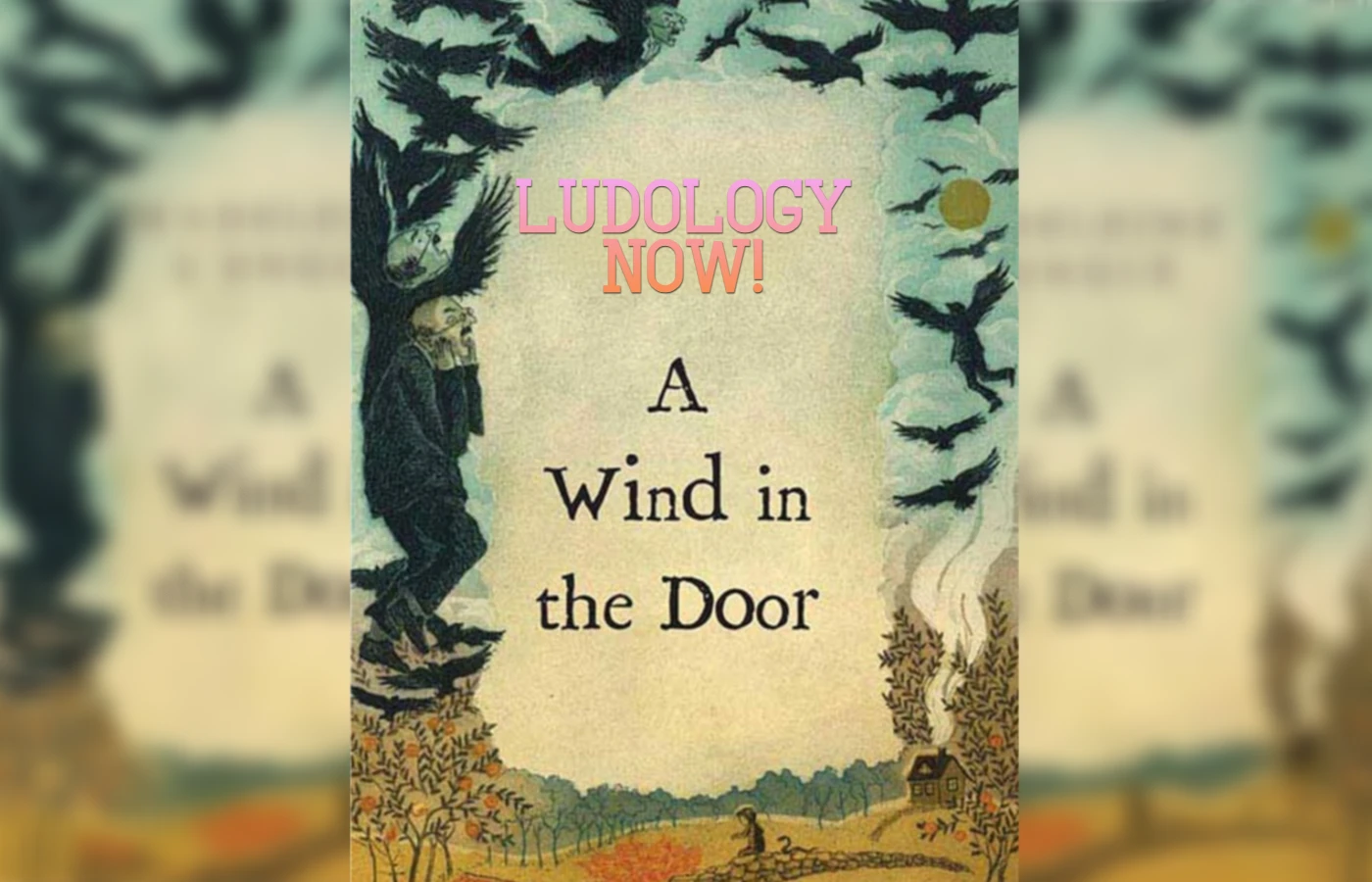
A Wind in the Door
I worry about how much Madeline L’Engle has shaped my philosophical views of the universe.
Over the past few weeks I’ve been rereading a number of books that I feel contributed to my childhood and mentality in some way. I’ve been through A Wizard of Earthsea and The Tombs of Atuan by Ursula K. Le Guin, Hatchet by Gary Paulsen, Flight of Passage by Rinker Buck, and now I’m working my way through L’Engle’s Time quintet.
A Wrinkle in Time was about exactly as I remembered it, although with a few more pro-Christian and anti-Communism notes than I previously noticed. It wasn’t until re-reading through A Wind in the Door that I began to really become conflicted.
The main plot of A Wind in the Door concerns mitochondria and farandolae, and how the death of farandolae inside mitochondria causes the mitochondria itself to die. The book very overtly draws parallels between this microscopic interaction and how the deaths of humans can spell ruin for the entire galaxy.
Now, this is where things get complicated. I have believed, all of my life that I can remember, that plants, rocks, trees, animals, fish, insects — everything, really — are just as alive and sentient as human beings are. There is no difference, to me, deep down. Trees grow and die and think and love and eat and bleed just like the rest of us.
A Wind in the Door strongly supports this theory and presents it as an objective truth, at least where animals, plants, and other ‘visibly live’ beings are concerned. It also couches everything under a greater umbrella, a very religious one, where all that is good and bright and lovely is always working against all that is evil, equal, and (as always) represented by the dark.
Farandolae, of course, are not real, nor is the disease ‘mitochondritis’ from which Charles Wallace suffers, although there are real-world analogous medical issues. Unfortunately, we haven’t yet figured out how to solve those by the power of love and names.
Do I believe what I believe about the world because I read A Wind in the Door over thirty years ago? It’s possible, I suppose, although those beliefs I feel to be true so strongly that I cannot say for certain I did not have the thought myself. Surely, if the thought was already there, reading it in the book would have only strengthened my feelings.
But what if it did spring out at me, wholly unprompted, and I just took it as gospel over the years as the words turned over in my subconscious? What else, then, is a part of me that I absorbed without knowing it? How much of ourselves are we?
There are times when I believe we are nothing but a combination of all the input we have ever received up to that point filtered through the brain we were born with and the soul we’ve had since the beginning of our journey. The rest is like Thesus’ ship, ever changing, always itself and yet made of a thousand disparate parts. How many books on these shelves did I use to build myself?
The ones by Asimov must be included, surely, and Le Guin as previously noted. K.A. Applegate and C.S. Lewis. Bruce Coville. Mario Puzo and Douglas Adams, Ian Fleming and Mark Twain, James Rollins, Chuck Palahniuk, another C.S. with Forester, Hemingway, of course. They are all a part of me.
It is interesting to bring up Applegate (author of the excellent Animorphs series) at the same time as A Wind in the Door. One could not imagine Applegate agreeing with many of L’Engle’s ‘American excellence’ themes, yet both created a special language for creatures without mouths to speak with each other directly, mind-to-mind.
Applegate’s books, steeped in the moral follies of war, have aged better than many others mentioned. Words of exclamation, of condescension, of identification, could have been chosen by their writers more wisely, more humanely, at times. There are some lines of dialog that do not hold up to any form of scrutiny and can only be apologized for. How much of that has evilled its way into my head, too?
“Here we are, at the height of civilization in a well-run state in a great democracy. And four ten-year-olds were picked up last week for pushing hard drugs in the school where our six-year-old is regularly given black eyes and a bloody nose.”
If I remember correctly, the overtly pro-Christian, pro-American nature of L’Engle’s Time series only grows as the books continue. Surely the above quote, taken from A Wind in the Door, feels far ‘preachier’ than anything in Wrinkle. How much innate post-war Americana remains in me, was there long before I played Fallout on PC?
It would not take much to present A Wind in the Door as a fundamentally conservative piece of fiction, despite (or perhaps in agreement with?) its assertions about the nature of individuality. Near the end of the book a crisis hinges on the ‘Deepening’ of the farandolae, a process which is described not unlike a teenager becoming an adult. The farandolae are refusing to Deepen, choosing instead to sing and dance and suck nourishment from the ‘fara’ from which they came.
If I were to mention the year of publication was 1973, would that perhaps give the previous paragraph a different context? Just how analogous to the free love moment is the story of the farandolae, and how do you think L’Engle felt about teenagers in the late 1960s and early 1970s? I don’t know the answers to these questions, although I guess at them, but I do know that the payoff for the book’s title is incredibly poor.
Many Waters is set during the time of Noah and directly involves multiple biblical characters, as well as angels and demons. If A Wind in the Door dipped its toes into more religious themes by featuring a single cherubim, Many Waters dives in head first with multiple Nephilim and Seraphim.
I am not a Christian person, although I am a religious one in the sense of what I said before. I believe all of us are part of the same thing, the same great cycle, and that the movement of protons and electrons is nothing different from the movement of planets around a sun. I know this to be true, not because I read it in a book, but because the trees and the squirrels and the dogs and the flowers and the water tells me so.
But farandolae aren’t real.
THIS WEEK’S RECOMMENDED MEDIA
About the Author

Discover more from Bonus Action
Subscribe to get the latest posts sent to your email.