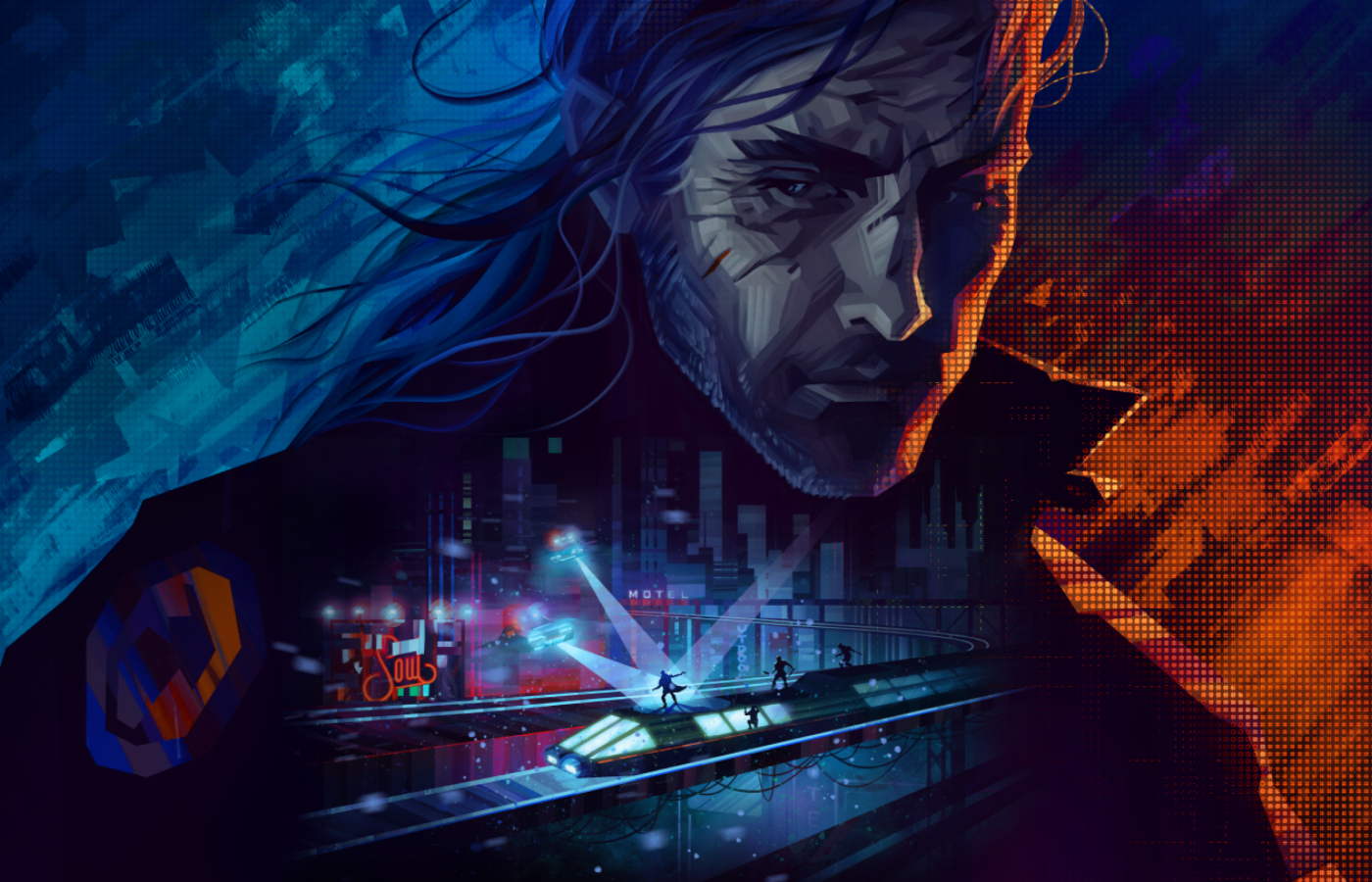
At some point while playing REPLACED, you will stop moving. Not because you died, not because you’re stuck on a puzzle, but because something on-screen will catch you so completely off guard that your thumbs give up and you sit there, controller in hand, F12 key already on its third life from all the screenshots you’ve taken. It happens in the first hour and again in the third, and by the end, you’ve lost count.

REPLACED launched April 14, 2026, the debut project from Sad Cat Studios, eight years in the making. Critics immediately reached for the biggest words they had. Neowin called it “one of the most stylish and cinematic games I have ever played.” GamingBoulevard wrote: “Time and time again, I think we have reached the pinnacle of pixel art in video games. And time and time again, I am proven wrong.”
The question is how a pixel art game made by a small debut studio manages to do that repeatedly, almost casually, when games with ten times the budget and ten times the team can go entire playthroughs without producing a single image worth pausing for.
So we called the people responsible and asked.
It’s Giving Blade Runner
The 1980s America of REPLACED is one where nuclear catastrophe bent history sideways: organs are currency, corporations are government, and neon bleeds over everything. You play as R.E.A.C.H., an AI shoved into a human body, learning the hard way that flesh comes with complications.
It is a 2.5D game, meaning you move through a world that exists in full three dimensions, like a stage set with real depth, real lighting, and real shadow, where the actors have been drawn by hand, frame by frame, in pixel art.
Which is all well and good, but none of it explains why you can’t stop staring at it.
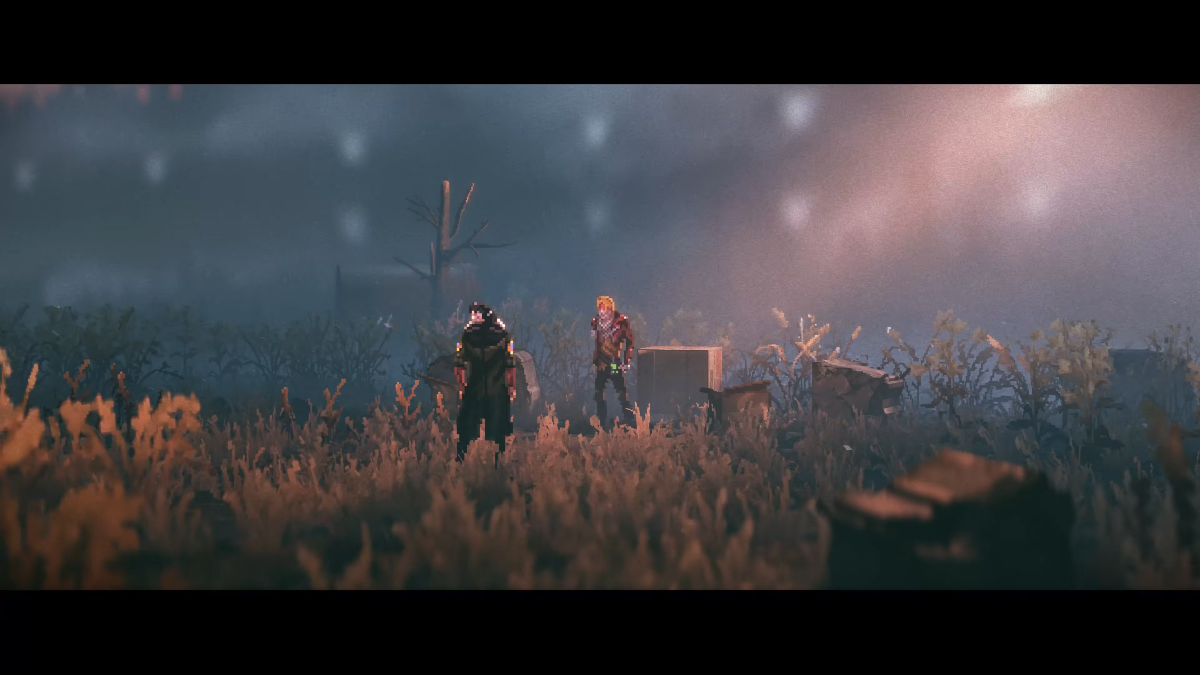
Yura Zhdanovich, founder and director of Sad Cat Studios, never treated the visuals as decoration. They were load-bearing. “I would say the art style is basically the sauce of this game,” he told us. “A lot of creative and gameplay decisions have been mostly based around how we can exploit this art style in the most effective and beautiful way.”
Most studios cook the meal first and season it afterward. Sad Cat Studios started with the sauce. Everything else, the story, the combat, the cameras, the lighting, was built around making that sauce taste exactly right.
Self-Taught, Eight Years, One Shot
Sad Cat Studios started in 2018 with three people in a room, Yura describes simply as “tiny”, and ambitions that were, at first, considerably more modest.
Yura’s background was in linguistics, not game design, which either explains everything or nothing. “At first it should have been like just pixel art,” he said. “And I realized very, very fast that just usual pixel art wouldn’t do it. Especially for me.”
In 2017, a trailer for The Last Night, a game that has been coming out any day now for nine years, appeared at Xbox’s E3 showcase and showed him exactly what he’d been groping toward: pixel art fused with modern 3D lighting, retro and cinematic at once.
Seeing it, apparently, was all he needed. What followed was a full inversion of the original approach. The team had tried to make a 2D game look 3D, then they flipped it. “The only thing 2D in the game is the characters,” Yura explained. “Everything else is just super stylized 3D.”
The crumbling walls, the rusted catwalks, the neon hotel signs, the industrial sewers, all three-dimensional geometry dressed up as pixel art, with hand-drawn characters moving through it. The result tricks your eye constantly, sitting in two registers at once, neither quite a game nor quite a film, and somehow completely both.

Yura taught himself everything, which sounds implausible until he explains how. He studied films the way a cook studies a recipe, taking them apart to understand exactly what made them taste the way they did.
He tracked down a camera lens used on Matt Reeves’ The Batman after a chance meeting with photographer Lion Wong at Gamescom, fascinated by what cinematographers do to make footage feel textured rather than just sharp.
He replayed Playdead’s Inside the way a film student rewinds a Kubrick scene, asking what each angle was doing and why.
“I’ve just explored and looked at a lot of things,” he said, “trying to digest them, analyze them. I think I just got a keen eye on things, to select those things that probably should be studied and analyzed.”
The game looks the way it does because someone watched enough films to understand that how you point a camera is as important as what you point it at, and then spent eight years proving it.
Every Camera Was Put There on Purpose
In the average side-scrolling game, the camera follows you. It keeps your character in frame, adjusts when you jump or fall, and does what it needs to do and nothing more, the visual equivalent of a loyal golden retriever who has never once had an artistic opinion.
Jaime Delmonte, the cinematographer who joined Sad Cat Studios to design every shot in the game, would like you to know that REPLACED’s camera is not that. “Not a single camera in the game is done in an automatic way,” he said.
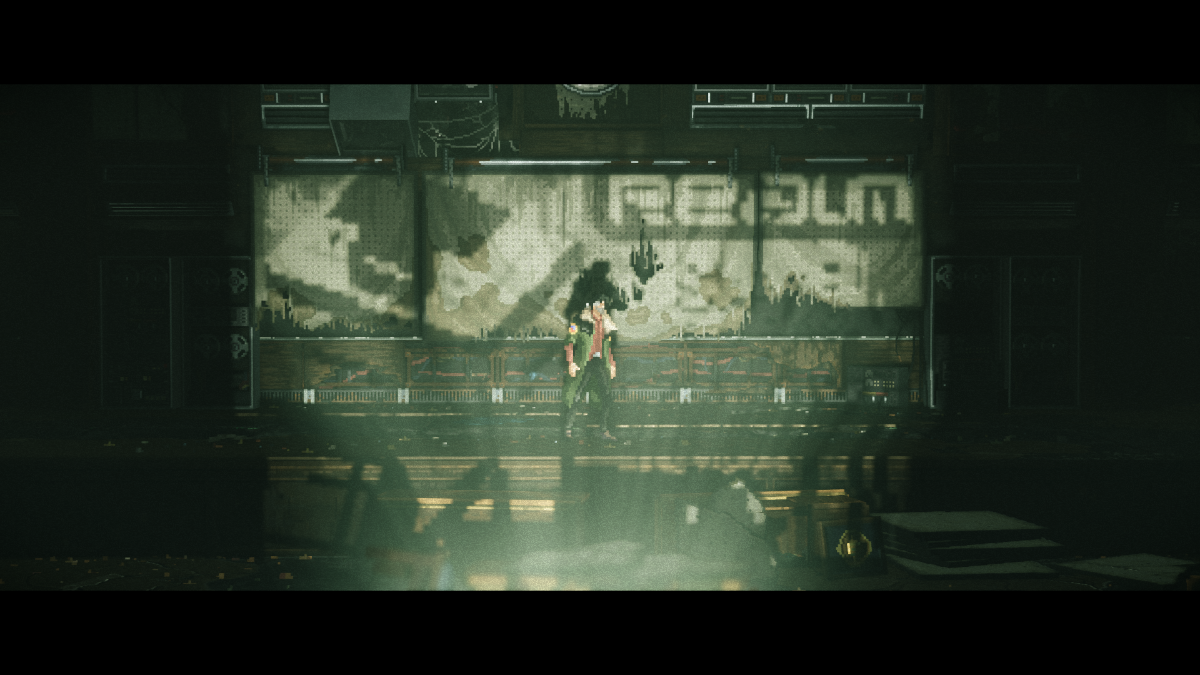
Every position, for every hallway and rooftop and diner and sewer and moment of quiet and moment of chaos, was manually placed. Someone decided where the camera sat, how it moved, what it showed you, and what it withheld. Think of a film director blocking every shot on a set, except the set is an entire video game, and there are no takes.
This is what you’re responding to when a shot catches your breath. The police drone hanging in a burnt-orange sky, camera slightly below it, the city stretching indifferently behind it in the fog, communicates scale and institutional menace in a single frame because someone put the camera precisely there.
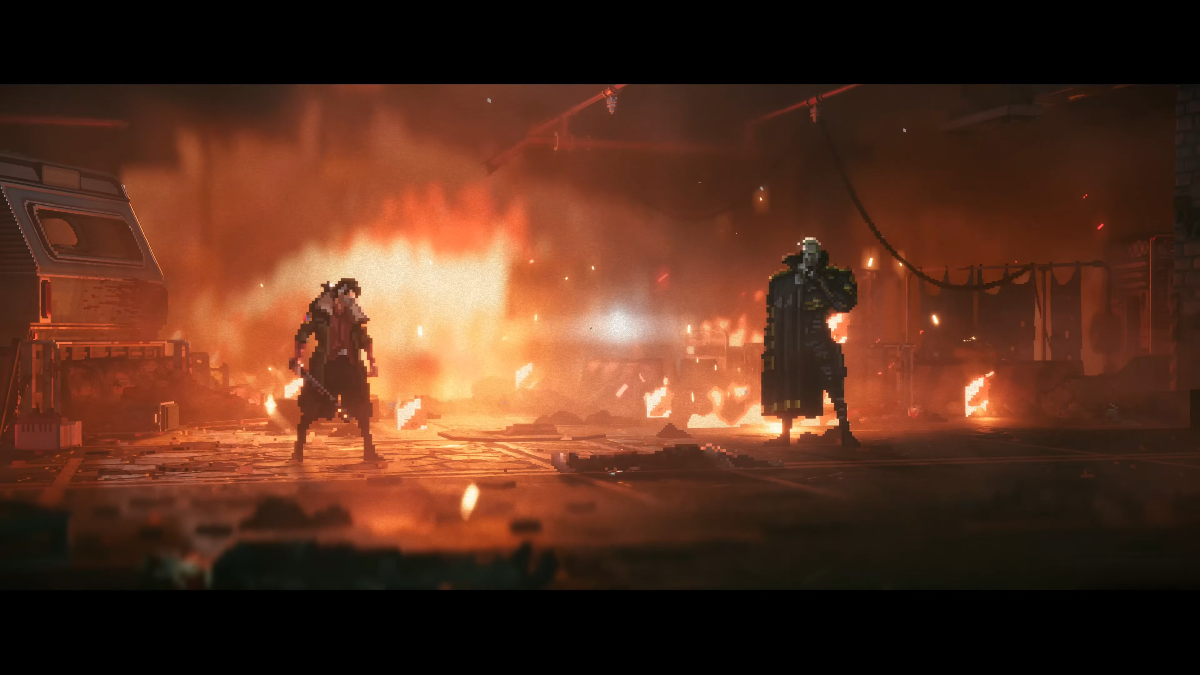
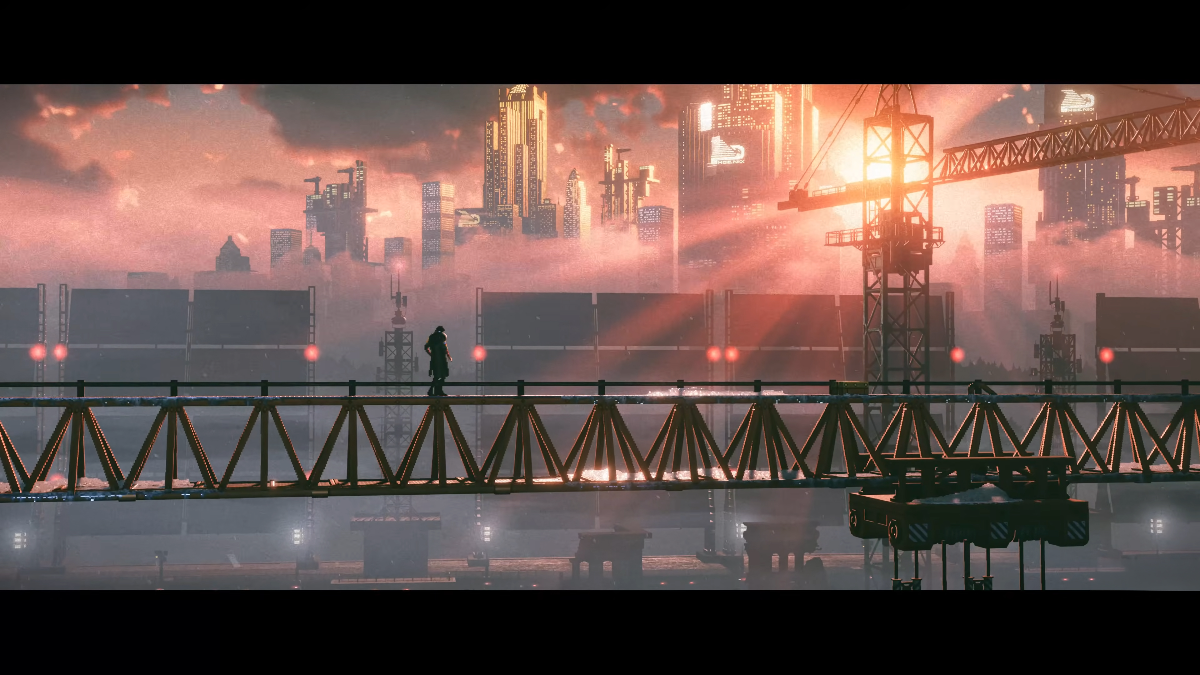

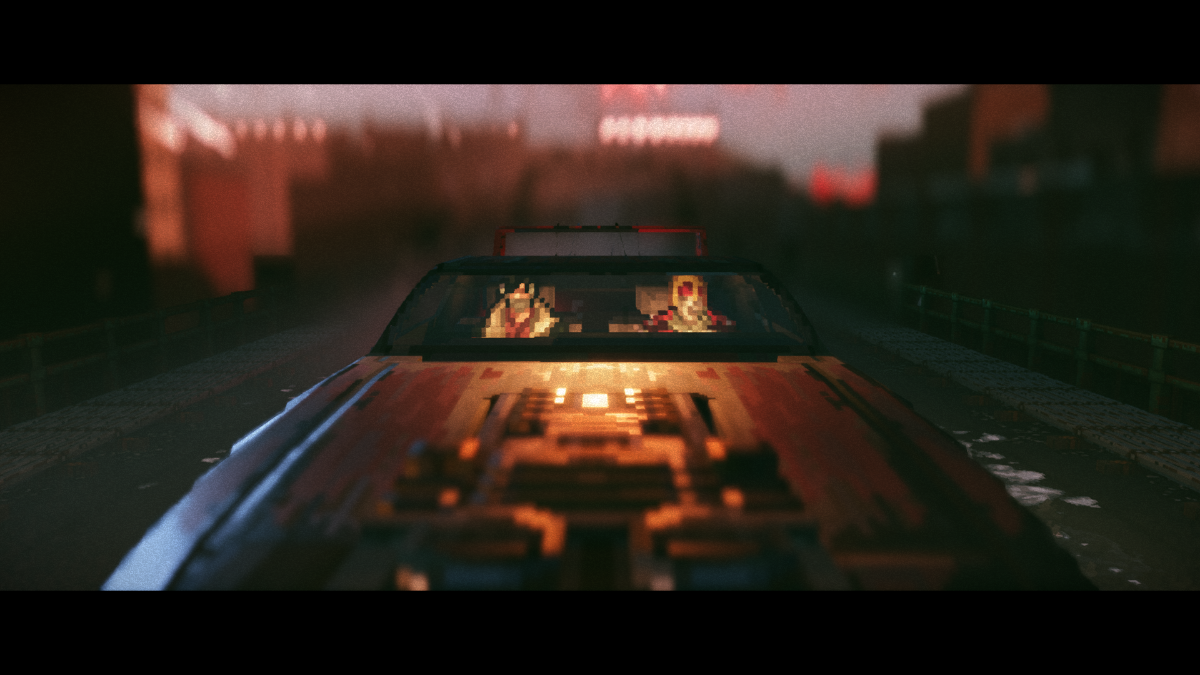
R.E.A.C.H. standing in a blood-red corridor, a tiny figure against deep shadow, the camera pulled so far back he almost disappears into the architecture: that feeling of being exposed and dwarfed and very much alone is also a decision.
Jaime’s goal was for none of it to register as one. “If most players experience all of this without even realizing the work behind it,” he said, “it’ll mean we did a great job.”
Like Yura, Jaime learned by studying obsessively. Inside, above all else, replayed specifically to understand how cameras inhabit a world. Naughty Dog’s Uncharted is for intentional, story-driven composition. Silent Hill, Resident Evil, and Alone in the Dark for the way a fixed angle can quietly commandeer a player’s attention without them ever noticing.
“It was important that the player was always inside the game,” he said, “and that we would direct his attention without him even realizing it. If a camera transition was too much or a composition was too far from the general tone, that was definitely not the proper direction.”
Let There Be (Exactly The Right) Light
Yura’s team built their own rendering pipeline from scratch. Not borrowed, not adapted… built. That sentence alone should tell you something about how seriously these people take a lamp.
The reason, as Yura explained it: “The character is flat. So he wouldn’t have any shadows beneath him.” Put a sprite into a three-dimensional world with real lighting, and it just sits there, weightless, a sticker pressed onto a film set backdrop.
The solution was to hang lamps everywhere, at precise angles designed to catch flat sprites and give them physical weight. “There were a lot of small lights, actually, in this game, like lamps. There are a lot of those in different scenes.” Those lamps are not just for atmosphere. They are, in the most literal sense, holding things together, the seasoning that makes the whole dish work.
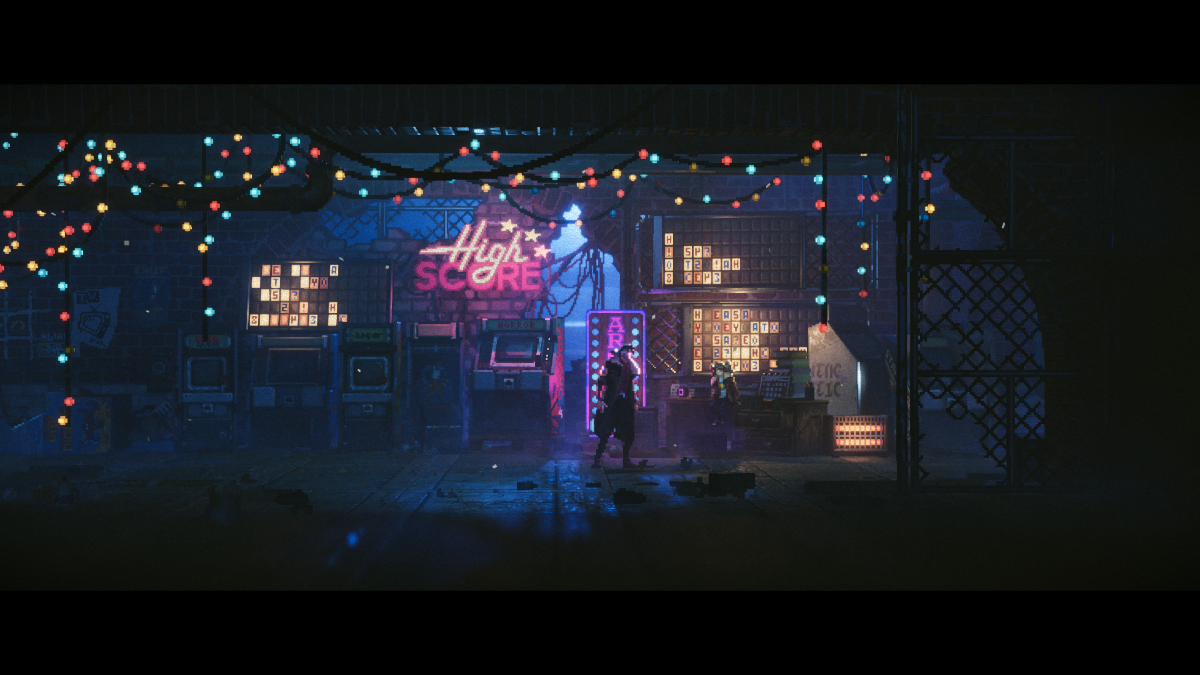
The game runs up to 60 real-time light sources simultaneously, in something modest enough to run on a GTX 1060. Not because it was efficient, but because Yura treats every lighting decision the way a chef treats seasoning: it either serves the dish or it doesn’t.
“This scene is kind of very sad, so I need to basically elevate the sadness with the good lighting,” he said. “So that’s lighting 101.”
Lighting 101, he says, as if he didn’t spend eight years and a custom rendering engine getting there.
Nobody Will Notice. Do It Anyway.
Konstantin Brailov’s job, if he had to name it, is composition, and he means that in every possible sense of the word. “I’m building the layout of a level, setting the rhythm of the action, and balancing contrasts, not just visual ones, but emotional and auditory ones too,” he said.
Every cinematic in the game began as a script that Konstantin translated into moving images, the way a recipe on paper becomes something that makes you close your eyes on the first bite.
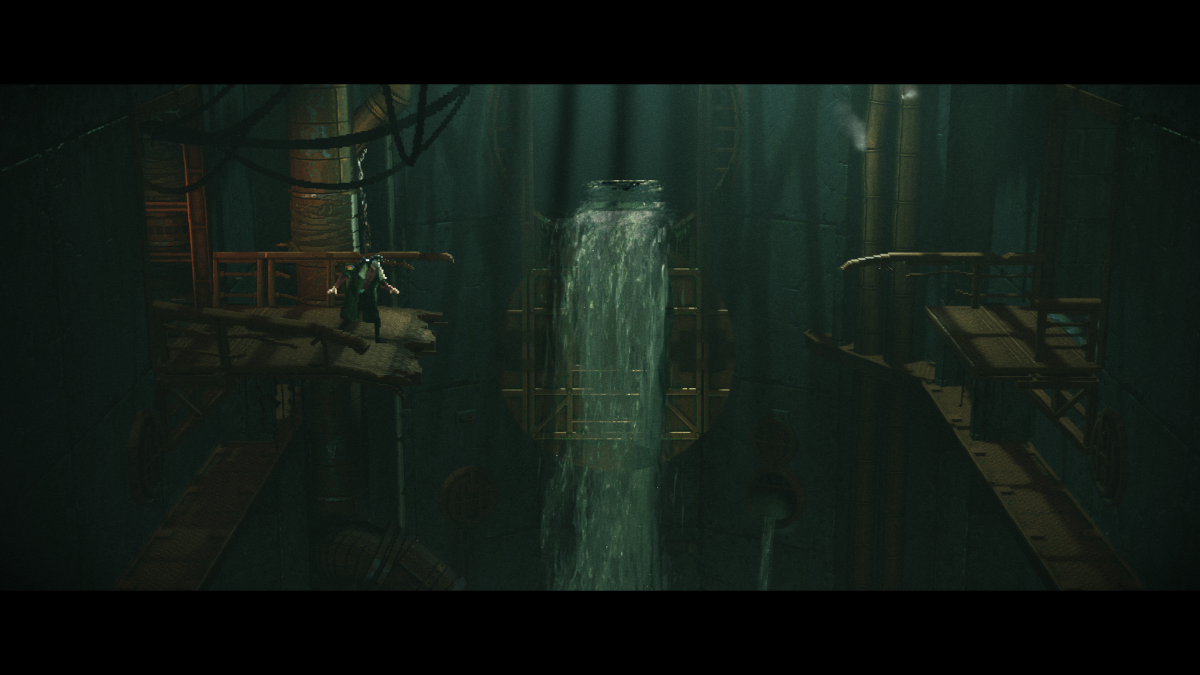
The moments Konstantin is proudest of are the ones most players likely walked straight through.
The Sewers, because he refused to make them filler: “I wanted to set a mood so that when players look back, they have a vivid image of the hardships the hero had to endure.”
A cave before the lab, irregular and awkward to build from modular pieces, coaxed into feeling organic. The Cathedral Flashback: “a farewell to an old friend. I had to balance bright, colored light with deep shadows and blend them into a symmetrical composition, all while finding the perfect camera speed.”
Finding the perfect camera speed. Not just where the camera is, but how fast it moves through a single emotionally loaded shot. Someone worked that out for every scene in the game. The precision underneath the beauty is genuinely staggering, and I say that as someone who had to have it explained to them slowly.
Konstantin also mentioned: “One of my proudest contributions: you can actually pet the dog in the game.” This is the most important sentence in this article.
On Not Being Able to Look Away
Screenshots get you partway there, but not all the way, so it’s worth trying to describe what you actually move through.

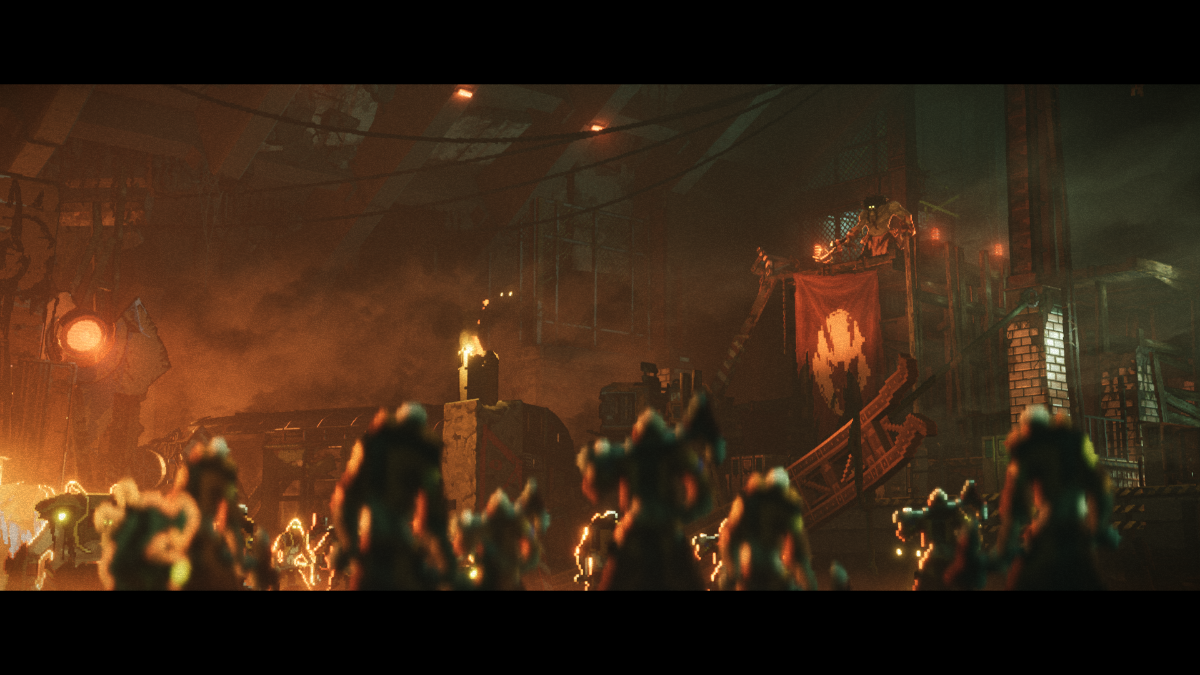
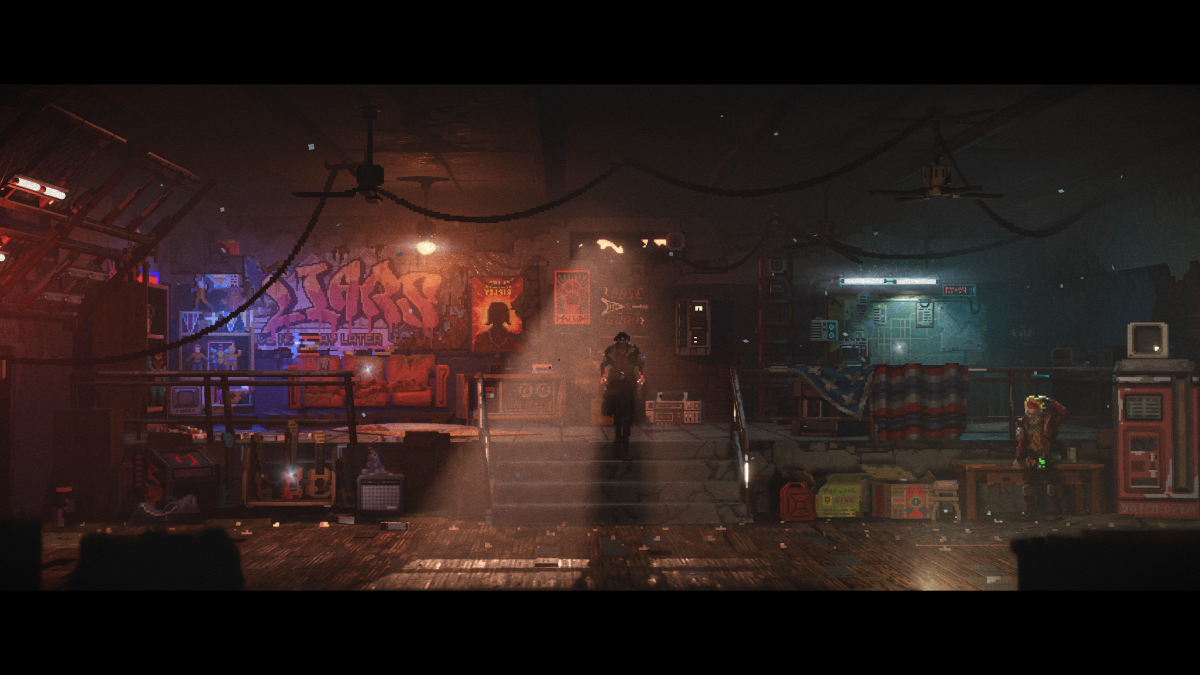
There is a diner early in the game, lit by fluorescent tubes the color of old cooking oil, red vinyl booths worn to rust, and through the window Phoenix-City the way you might see any American city from a diner window in 1983: fire escapes, water towers, the specific quality of light that says the world beyond that glass is both dangerous and fully alive. People are eating alone inside. The place has a history you will never fully know.
There is a forest outside the city, dead trees and mud and orange underbrush and a mist so thick it softens the drone lights floating through it into amber halos above ruined ground, while water pooled on the forest floor catches the light and breaks it into pieces.
There is a lab, green-lit and cold, built for one purpose. R.E.A.C.H. is strapped to something at its center, small beneath a bank of monitors displaying his own name back at him, the machinery around him both functional and ceremonial in the way that instruments of control always are.
There is Phoenix-City itself, seen from outside in the snow: a hotel sign burning rose-pink neon, the skyline climbing into purple cloud and lit windows, snow falling past a figure on a ledge so small he might not be there at all.
The Honest Answer, and Why It’s the Wrong One
Asked whether, after eight years of staring at it, the game still looks beautiful to him, Yura said that on his computer, it looks ugly. That is his word: Ugly.
On his Xbox, playing it the way a stranger would, it looks okay. “I wouldn’t say it looks incredible. It looks okay to me.” Then, without missing a beat: “If you don’t try to outdo yourself every time you hit some milestone, you’re not getting anywhere. Being an artist is mostly about self-discipline in that regard. Like the notion that you force yourself to do better.”

Near the end of our conversation, I asked Yura what it felt like to have built something this singular, something he describes as a one-off, unrepeatable, not because he says so, but because the specific combination of people and years and stubbornness that made it cannot be reassembled.
“It’s more about the art, to be honest. Because of the art of game development, it’s a very interesting endeavor to make video games. And if you’re into it, you’re like 100% into it. So I think I found a perfect place to make a living.”
REPLACED landed a 79 on Metacritic, a 78 on OpenCritic, with 86% of critics recommending it, Very Positive on Steam, and MoistCr1tikal calling it so good he made a whole video about it.
“I don’t feel like it’s out,” Yura admitted.
It is out. Whatever Sad Cat Studios makes next, REPLACED is already one of those games, like a specific film or album, that people will remember encountering for the first time: the screenshot that stopped the scroll, the moment they booted it up and understood it was going to be one of those, the moment the controller went down, not because they were stuck, but because they simply couldn’t look away.
About the Author

Discover more from Bonus Action
Subscribe to get the latest posts sent to your email.